- Democracy in West Africa: Beyond Elections, Toward Accountability
- ECOWAS Integration: Stop the Political Lip Service
- Ghana’s Cedi Crisis: Citizens Deserve Monetary Stability
- Nigeria’s Oil Dependency: Time to Break the Curse
- United States Signals Continued Tight Monetary Policy Amid Inflation Concerns

Middle East Leaders Renew Talks on Regional Security Cooperation
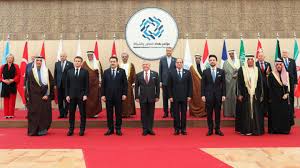
Leaders from several Middle Eastern countries have renewed discussions on regional security cooperation following a high-level meeting held in Riyadh, Saudi Arabia, on 18 November. The talks brought together foreign ministers, national security advisers, and senior military officials from Gulf Cooperation Council states, alongside representatives from Egypt, Jordan, and Iraq.
The meeting was convened by the Government of Saudi Arabia as part of a continuing diplomatic track aimed at reducing regional tensions and strengthening collective security mechanisms. Discussions focused on maritime security, counter terrorism coordination, border stability, and economic cooperation as a stabilizing pillar for long term peace.
In opening remarks, the Saudi Foreign Minister stated that the region faced shared security challenges that could not be effectively addressed through unilateral action. He noted that “regional stability requires dialogue, trust building, and practical cooperation. No country can insulate itself from insecurity in neighbouring states.”
According to officials present at the meeting, maritime security featured prominently on the agenda, particularly the protection of shipping lanes in the Red Sea and the Gulf region. A senior Gulf official stated that “secure maritime corridors are essential to global trade and energy markets. Any disruption affects not only the region but the wider international economy.”
Counter terrorism cooperation was also discussed, with participants reviewing intelligence sharing frameworks and joint capacity building initiatives. An Egyptian delegation member explained that “terrorist networks adapt quickly. Our response must be equally adaptive, coordinated, and based on shared intelligence and operational trust.”
Economic integration was presented as a complementary pillar to security cooperation. Delegates discussed infrastructure connectivity, energy collaboration, and trade facilitation as tools for reducing conflict drivers. The Jordanian Foreign Minister observed that “economic opportunity strengthens social stability. When people see tangible benefits from cooperation, the space for extremism narrows.”
The Riyadh talks followed a series of bilateral engagements earlier in the year aimed at restoring diplomatic channels among regional actors. Analysts note that while deep political differences remain, the resumption of multilateral dialogue signals a pragmatic shift toward risk management rather than confrontation.
Data from regional security assessments presented during the meeting indicated that maritime incidents and cross border security threats have declined in some areas following improved coordination, though vulnerabilities remain. Officials acknowledged that progress has been uneven and requires institutional follow through.
At the conclusion of the meeting, participants agreed to establish a standing technical working group to oversee implementation of agreed confidence building measures. The group is expected to focus on maritime surveillance coordination, joint training programmes, and information sharing protocols.
A joint statement issued after the talks emphasized respect for sovereignty, non-interference, and dialogue as guiding principles. It also confirmed that the next round of consultations would be hosted by Jordan in the first half of the coming year.
Regional policy analysts described the Riyadh meeting as incremental but significant. They cautioned that sustained engagement and measurable outcomes would be required to translate dialogue into lasting stability.
If maintained, the renewed security cooperation framework could contribute to reduced escalation risks and improved economic confidence across a region that remains central to global energy supply and trade routes.